


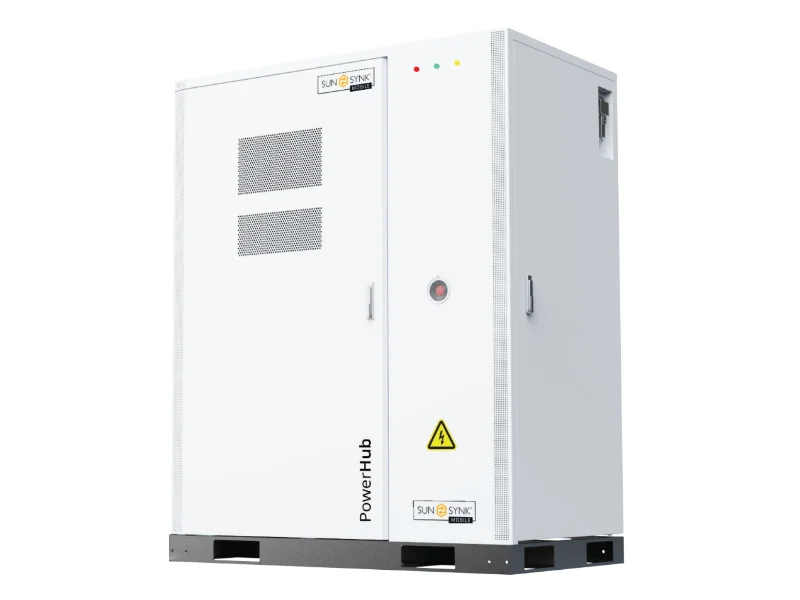




Sunsynk PowerHub 50kW Three-Phase Hybrid System with 122.8kWh Battery Storage
Keep your business powered and make better use of your solar energy with the Sunsynk PowerHub. This integrated commercial energy storage system combines 50kW of three-phase output with 122.8kWh of lithium battery storage, giving your property a substantial energy reserve for backup power and daily energy management.
Designed for businesses with higher electricity requirements, the PowerHub brings the inverter, batteries and energy management technology together in a floor-mounted cabinet solution. It is a practical option for offices, commercial premises, workshops, agricultural facilities and other sites where dependable power matters.
Protect Your Operations and Use More of Your Solar Energy
Keep Essential Equipment Running
The PowerHub supports off-grid operation, allowing a correctly designed installation to supply selected loads when grid power is unavailable. This can help keep lighting, communications, refrigeration and other important equipment operating during outages, within the system’s power and energy limits.
Store Energy for When Your Business Needs It
Pair the PowerHub with a suitable solar array to store energy for use later in the day or during an outage. Using stored solar energy can help reduce grid electricity consumption, depending on your solar generation, operating hours and electricity usage.
Manage Higher Commercial Loads
The 50kW inverter supplies three-phase power for suitable commercial applications. The datasheet also specifies an off-grid peak output of 1.5 times rated power for up to 10 seconds, providing short-duration overload capability. Equipment with high starting currents must still be assessed during system design.
Integrated Power Conversion and Energy Management
The PowerHub incorporates power conversion equipment, a hybrid inverter, a Battery Management System (BMS) and an Energy Management System (EMS). These components work together to manage energy flow and battery operation.
- Hybrid operation: combines solar energy, battery storage and grid interaction in a professionally configured installation.
- Battery management: monitors and manages the lithium battery system.
- Energy management: coordinates the system’s charging, discharging and energy use.
- Black-start support: supports starting without an active grid supply, provided the battery and system conditions permit.
- Integrated cabinet design: brings the principal storage and conversion components together in one coordinated solution.
122.8kWh of Lithium Iron Phosphate Battery Storage
The PowerHub uses Lithium Iron Phosphate (LiFePO4) batteries and is designed for repeated charging and discharging. Its substantial storage capacity makes it suitable for businesses looking to improve backup capability and increase the use of stored energy.
- System energy configuration: 122.8kWh.
- Battery operating voltage: 500–700V.
- Individual battery module capacity: 5.12kWh.
- Individual battery module nominal voltage: 51.2V.
- BMS communication: CAN.
- Specified cycle life: at least 6,000 cycles under the manufacturer’s stated test conditions.
Understanding Your Backup Duration
The inverter’s 50kW rating describes how much power it can supply, while the battery’s 122.8kWh rating describes the nominal energy stored. Actual backup duration depends on the connected loads, available usable energy, battery state of charge, reserve settings and conversion losses. We can help assess your requirements to determine whether this system suits your operating needs.
Solar Integration with Four Independent MPPT Trackers
The inverter supports up to 65kW of PV input power and includes four MPPT trackers. These trackers help optimise energy collection from appropriately designed solar strings and provide flexibility when arranging the solar array.
- Maximum PV input power: 65,000W.
- Number of MPPT trackers: 4.
- MPPT operating voltage range: 150–850V DC.
- Rated PV input voltage: 600V DC.
- Start-up DC voltage: 180V DC.
- Maximum PV input current: 36A per MPPT.
- Maximum PV short-circuit current: 55A per MPPT.
- Maximum inverter efficiency: 97.6%.
- MPPT efficiency: 99.9%.
The solar panel quantity and string arrangement must be selected to meet the inverter’s electrical limits and the site’s installation conditions.
Battery Expansion for Growing Energy Requirements
The datasheet lists support for up to six units in parallel and battery expansion to a maximum stated capacity of 1,200kWh. This provides scope for larger energy storage projects as your business requirements grow.
Battery expansion and inverter paralleling are separate design considerations. The final storage capacity, total output power and equipment arrangement must be confirmed for the proposed configuration.
Built-In Monitoring and Protective Features
The PowerHub includes a range of detection and protective systems to support commercial battery operation:
- Combustible gas detection.
- Smoke and temperature detection.
- Active exhaust system.
- Fire alarm.
- Aerosol fire-extinguishing protection for the battery pack and system.
- Power supply redundancy design.
The datasheet also identifies battery temperature control below 35°C during rated-power operation. Suitable positioning, ventilation and installation clearances remain important for effective operation.
Display and Communication
An LCD display provides access to operating information. The inverter supports CAN, RS485, Wi-Fi and Ethernet communication, providing interfaces for compatible monitoring and control arrangements.
Monitoring access and connectivity will depend on the equipment configuration and available network connection.
Key System Specifications
- Nominal output / UPS power: 50,000W.
- Grid type: three-phase with neutral and protective earth.
- AC voltage: 220/380V or 230/400V.
- AC frequency: 50/60Hz.
- Rated AC output current: 75.8A.
- Energy configuration: 122.8kWh.
- Maximum charging/discharging efficiency: 91%.
- Enclosure protection: IP55.
- Installation style: floor-mounted.
- Overall dimensions: 1,764 × 1,050 × 2,250mm (W × D × H).
- Approximate system weight: 1,980kg.
- Power factor: 0.8 leading to 0.8 lagging.
- Total harmonic distortion: below 3%.
Operating Conditions
- Inverter operating temperature: −40°C to 60°C, with output derating above 45°C.
- Battery charging temperature: 0°C to 55°C.
- Battery discharging temperature: −20°C to 55°C.
- Inverter relative humidity: 15%–85%, non-condensing.
Battery Module Details
- Module dimensions: 440 × 570 × 133mm (W × D × H).
- Module weight: 44kg.
- Cycle-life test conditions: 25°C ±2°C, 0.5C charging and discharging, with 70% end-of-life capacity.
- Listed battery certifications: UN38.3, IEC62619 and IEC61000.
Installation and System Planning
The PowerHub requires professional installation and a suitable load-bearing base. With an approximate weight of 1,980kg, site access, handling arrangements, foundation capacity and installation clearances should be assessed before delivery.
Your system design should also account for the property’s electrical supply, essential loads, solar array, protection equipment and applicable connection requirements. Solar panels, mounting structures, installation work and other project components should be confirmed in the quotation.
Request a PowerHub Solution for Your Business
Take the next step towards stronger backup capability and better control of your energy use. Contact JC Solar Panels for current pricing and a quotation suited to your property.
Kindly share your location, electricity usage, three-phase supply details, and the equipment you would like to keep running. Our team can help assess the appropriate PowerHub configuration and installation requirements.


Reviews
There are no reviews yet.